6 myths about cerebral palsy

Around 34,000 Australians live with cerebral palsy – and 1 in every 500 babies is diagnosed with it. But cerebral palsy (or CP) is often misunderstood and stigmatised. Not all people with CP use a wheelchair, have an intellectual disability or are unable to speak. This complex condition affects children and adults in different ways, with varying … Read more


What Role Does Empathy Play In Learning?

So much talk about empathy in education recently. Why? What’s the big idea? The role of empathy in learning has to do with the flow of both information and creativity. A dialogic interaction with the world around us requires us to understand ourselves by understanding the needs and conditions of those around us. It also … Read more

Crafting Fair Assessments for Flexible Assignments

Teachers are called to create deeper, more flexible learning opportunities for students to learn at high levels. This often raises questions about how to assess student work, given that student products may range from podcasts to digital storybooks, virtual reality experiences, and published poetry. To complicate things further, personalized products need to be graded equitably, … Read more

Perfume stinks: how fragrances can affect your health

If you avoid the perfume counter in department stores or wear a mask while cleaning your home, you’re not alone. They may smell sweet, but fragrances can make a person feel sick. About 1 in 3 people report having health problems when exposed to fragranced products. Those problems include asthma attacks, hay fever, headache, migraine, dizziness, breathing problems, rashes, congestion, nausea and seizures. According … Read more

Take medicines seriously

An estimated 9 million Australians take prescription medicine every day, and many more pop over-the-counter medications such as paracetamol and vitamins. Almost one-quarter of a million people are hospitalised each year due to problems caused by their medication. Medicines play a big role in daily life, so it ‘s crucial they ‘re taken properly and … Read more

Using Discussion as a Summative Assessment

Throughout my two decades in education, I have experimented with a variety of approaches to assessment, including projects, models, debates, and traditional assessments. In the past two years I’ve been teaching high school online, and I’ve abandoned traditional tests in favor of more compassionate forms of assessment. My new favorite is the discussion assessment, and … Read more

5 reasons to look after your eyes

You only get one pair of eyes. And while people often develop serious eye conditions as they age, or because of illness and injury, there are plenty of things you can do to protect your peepers from unnecessary damage. Here are 5 reasons to give your eyes more love and attention – before it’s too late.     … Read more

Testing times for HIV

New notifications of HIV (the Human Immunodeficiency Virus) have — overall — stabilised in recent years. But HIV diagnoses have also increased in some population groups. Australia has made great progress in HIV prevention within the gay community. For example, HIV diagnoses in gay and bisexual men in NSW in the first half of 2017 decreased by 31%. HIV … Read more

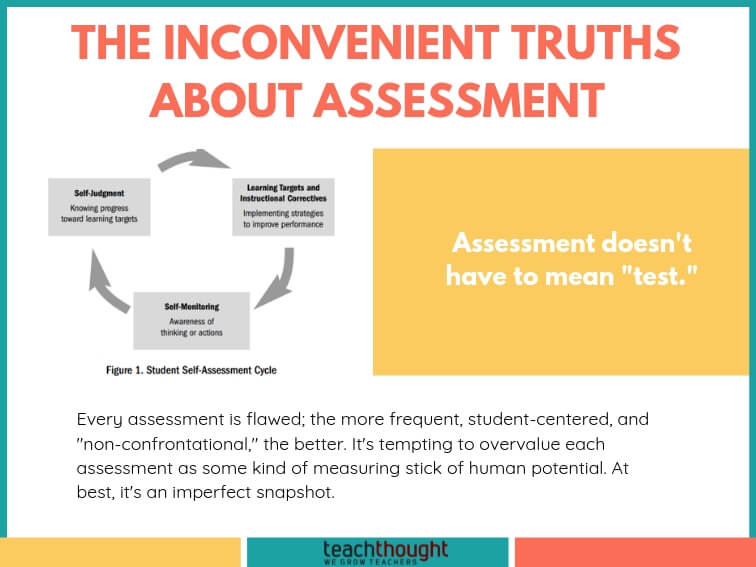
18 Inconvenient Truths About Assessment Of Learning

II. It’s an extraordinary amount of work to design precise and personalized assessments that illuminate pathways forward for individual students–likely too much for one teacher to do so consistently for every student. This requires rethinking of learning models, or encourages corner-cutting. (Or worse, teacher burnout.) III. Literacy (reading and writing ability) can obscure content knowledge. Further, language … Read more