A Guide to Psychological Safety for Educators

As a teacher, when you consider your workplace within your school system, how does it make you feel, and what people and experiences have shaped that response? Do you find yourself avoiding certain activities, locations, or colleagues because of what they’ve said about your new idea or how they’ve made you feel? Is reading this … Read more


Preparing Students With Disabilities for Life Beyond School

Family and school partnership is an important component of school success and student achievement. Engaging families of youth with disabilities is especially crucial. When students with disabilities enter middle and high school, schools and families need to begin to ensure that these young adults are prepared for life after graduation. As mandated by the Individuals with Disabilities … Read more

How School Leaders Can Pave the Way for Productive Use of AI

Leading in an era of rapidly advancing artificial intelligence (AI) requires that leaders articulate a clear vision, build consensus around it, communicate effectively with the school community, and allocate support and resources for their policies.  This is no small challenge: As school leaders, you must pave a path forward in uncharted educational terrain and make decisions that … Read more

Assessing Your School’s Mission and Vision

It’s no secret that when a principal takes a long look at the myriad of things and tasks to check off daily, weekly, and monthly, there are competing priorities that vie for their attention. In my experience as a school leader and mentor, one task that often gets overlooked is thoroughly examining the school’s mission … Read more

Emphasizing Growth, Not Grades, in Parent-Teacher Conferences

Conferences are a special time to connect with parents and guardians. However, too often, parents and students are more concerned about grades than about the learning that takes place to earn them. Unfortunately, by making the report card the star of the show, traditional models of parent-teacher conferences may unwittingly reinforce this shortsighted notion that … Read more

Using Student Data to Inspire Goal-Setting

Imagine sitting in your sixth-grade classroom at the beginning of the school year. Your teacher tells you that you are about to take a very important test and to try your best. You sit for over 45 minutes, answering many questions, most of which you don’t know how to answer. After the test, you are … Read more

What Role Does Empathy Play In Learning?

So much talk about empathy in education recently. Why? What’s the big idea? The role of empathy in learning has to do with the flow of both information and creativity. A dialogic interaction with the world around us requires us to understand ourselves by understanding the needs and conditions of those around us. It also … Read more

Crafting Fair Assessments for Flexible Assignments

Teachers are called to create deeper, more flexible learning opportunities for students to learn at high levels. This often raises questions about how to assess student work, given that student products may range from podcasts to digital storybooks, virtual reality experiences, and published poetry. To complicate things further, personalized products need to be graded equitably, … Read more

Using Discussion as a Summative Assessment

Throughout my two decades in education, I have experimented with a variety of approaches to assessment, including projects, models, debates, and traditional assessments. In the past two years I’ve been teaching high school online, and I’ve abandoned traditional tests in favor of more compassionate forms of assessment. My new favorite is the discussion assessment, and … Read more

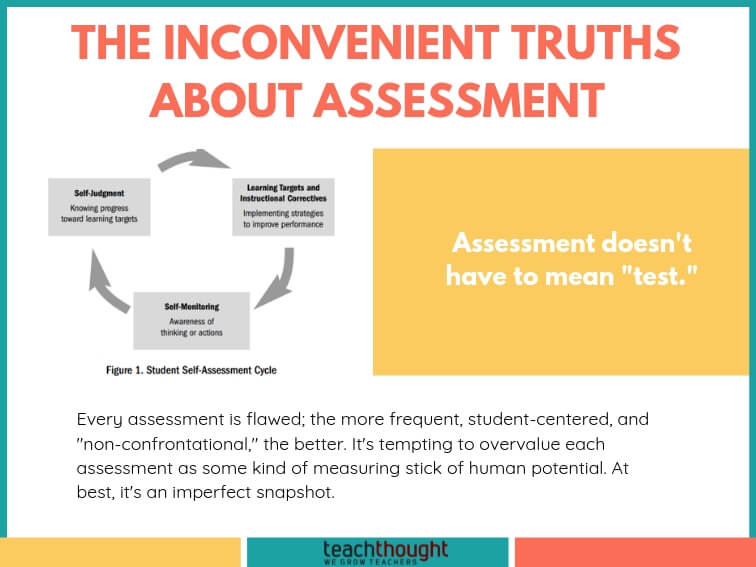
18 Inconvenient Truths About Assessment Of Learning

II. It’s an extraordinary amount of work to design precise and personalized assessments that illuminate pathways forward for individual students–likely too much for one teacher to do so consistently for every student. This requires rethinking of learning models, or encourages corner-cutting. (Or worse, teacher burnout.) III. Literacy (reading and writing ability) can obscure content knowledge. Further, language … Read more